A Member of the Boron Family Has Three Valence Electrons, While a Member of the Carbon Family Has
| Boron group (group 13) | |||||||||||||||||||||||||||||||||||||||||||||||||||||||||||||||||||||||||||||||||||||||||||||||||||||||||||||||||||||||||||||||||||||||||||||||||||||||||||||||||||||||||||||||||||||||||||||||||||||||||||||||||||||||||||||||||
|---|---|---|---|---|---|---|---|---|---|---|---|---|---|---|---|---|---|---|---|---|---|---|---|---|---|---|---|---|---|---|---|---|---|---|---|---|---|---|---|---|---|---|---|---|---|---|---|---|---|---|---|---|---|---|---|---|---|---|---|---|---|---|---|---|---|---|---|---|---|---|---|---|---|---|---|---|---|---|---|---|---|---|---|---|---|---|---|---|---|---|---|---|---|---|---|---|---|---|---|---|---|---|---|---|---|---|---|---|---|---|---|---|---|---|---|---|---|---|---|---|---|---|---|---|---|---|---|---|---|---|---|---|---|---|---|---|---|---|---|---|---|---|---|---|---|---|---|---|---|---|---|---|---|---|---|---|---|---|---|---|---|---|---|---|---|---|---|---|---|---|---|---|---|---|---|---|---|---|---|---|---|---|---|---|---|---|---|---|---|---|---|---|---|---|---|---|---|---|---|---|---|---|---|---|---|---|---|---|---|---|---|---|---|---|---|---|---|---|---|---|---|---|---|---|---|
group 12 ← → carbon group | |||||||||||||||||||||||||||||||||||||||||||||||||||||||||||||||||||||||||||||||||||||||||||||||||||||||||||||||||||||||||||||||||||||||||||||||||||||||||||||||||||||||||||||||||||||||||||||||||||||||||||||||||||||||||||||||||
| |||||||||||||||||||||||||||||||||||||||||||||||||||||||||||||||||||||||||||||||||||||||||||||||||||||||||||||||||||||||||||||||||||||||||||||||||||||||||||||||||||||||||||||||||||||||||||||||||||||||||||||||||||||||||||||||||
| ↓Period | |||||||||||||||||||||||||||||||||||||||||||||||||||||||||||||||||||||||||||||||||||||||||||||||||||||||||||||||||||||||||||||||||||||||||||||||||||||||||||||||||||||||||||||||||||||||||||||||||||||||||||||||||||||||||||||||||
| 2 | 5 Metalloid | ||||||||||||||||||||||||||||||||||||||||||||||||||||||||||||||||||||||||||||||||||||||||||||||||||||||||||||||||||||||||||||||||||||||||||||||||||||||||||||||||||||||||||||||||||||||||||||||||||||||||||||||||||||||||||||||||
| 3 | 13 Other metal | ||||||||||||||||||||||||||||||||||||||||||||||||||||||||||||||||||||||||||||||||||||||||||||||||||||||||||||||||||||||||||||||||||||||||||||||||||||||||||||||||||||||||||||||||||||||||||||||||||||||||||||||||||||||||||||||||
| 4 | 31 Other metallic | ||||||||||||||||||||||||||||||||||||||||||||||||||||||||||||||||||||||||||||||||||||||||||||||||||||||||||||||||||||||||||||||||||||||||||||||||||||||||||||||||||||||||||||||||||||||||||||||||||||||||||||||||||||||||||||||||
| 5 | 49 Other metal | ||||||||||||||||||||||||||||||||||||||||||||||||||||||||||||||||||||||||||||||||||||||||||||||||||||||||||||||||||||||||||||||||||||||||||||||||||||||||||||||||||||||||||||||||||||||||||||||||||||||||||||||||||||||||||||||||
| 6 | 81 Other metal | ||||||||||||||||||||||||||||||||||||||||||||||||||||||||||||||||||||||||||||||||||||||||||||||||||||||||||||||||||||||||||||||||||||||||||||||||||||||||||||||||||||||||||||||||||||||||||||||||||||||||||||||||||||||||||||||||
| seven | Nihonium (Nh) 113 other metal | ||||||||||||||||||||||||||||||||||||||||||||||||||||||||||||||||||||||||||||||||||||||||||||||||||||||||||||||||||||||||||||||||||||||||||||||||||||||||||||||||||||||||||||||||||||||||||||||||||||||||||||||||||||||||||||||||
| Legend
| |||||||||||||||||||||||||||||||||||||||||||||||||||||||||||||||||||||||||||||||||||||||||||||||||||||||||||||||||||||||||||||||||||||||||||||||||||||||||||||||||||||||||||||||||||||||||||||||||||||||||||||||||||||||||||||||||

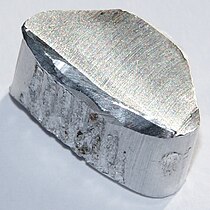
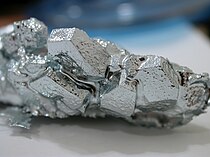
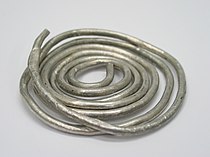
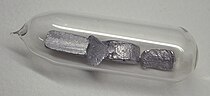
The boron group are the chemical elements in group 13 of the periodic table, comprising boron (B), aluminium (Al), gallium (Ga), indium (In), thallium (Tl), and perhaps also the chemically uncharacterized nihonium (Nh). The elements in the boron grouping are characterized past having three valence electrons.[ane] These elements have also been referred to equally the triels.[a]
Boron is usually classified as a (metalloid) while the rest, with the possible exception of nihonium, are considered post-transition metals. Boron occurs sparsely, probably considering battery by the subatomic particles produced from natural radioactivity disrupts its nuclei. Aluminium occurs widely on earth, and indeed is the tertiary virtually arable element in the Globe's crust (8.3%).[three] Gallium is found in the earth with an abundance of 13 ppm. Indium is the 61st about abundant chemical element in the earth'south chaff, and thallium is found in moderate amounts throughout the planet. Nihonium is not known to occur in nature and therefore is termed a synthetic element.
Several group 13 elements have biological roles in the ecosystem. Boron is a trace element in humans and is essential for some plants. Lack of boron can atomic number 82 to stunted plant growth, while an excess can also cause impairment by inhibiting growth. Aluminium has neither a biological function nor pregnant toxicity and is considered safe. Indium and gallium tin can stimulate metabolism;[iv] gallium is credited with the ability to bind itself to iron proteins. Thallium is highly toxic, interfering with the office of numerous vital enzymes, and has seen use as a pesticide.[5]
Characteristics [edit]
Like other groups, the members of this family unit show patterns in electron configuration, especially in the outermost shells, resulting in trends in chemic behavior:
| Z | Element | No. of electrons per shell |
|---|---|---|
| 5 | boron | ii, 3 |
| xiii | aluminium | two, viii, 3 |
| 31 | gallium | 2, eight, 18, 3 |
| 49 | indium | 2, eight, xviii, eighteen, 3 |
| 81 | thallium | 2, 8, xviii, 32, 18, 3 |
| 113 | nihonium | two, 8, 18, 32, 32, eighteen, 3 (predicted) |
The boron group is notable for trends in the electron configuration, as shown above, and in some of its elements' characteristics. Boron differs from the other group members in its hardness, refractivity and reluctance to participate in metallic bonding. An example of a tendency in reactivity is boron'south trend to form reactive compounds with hydrogen.[6]
Although situated in p-block, the group is notorious for violation of the octet rule by its members boron and (to a lesser extent) aluminium. These element may place merely six electrons (in iii molecular orbitals) onto valence vanquish. All members of the grouping are characterized equally trivalent.
Chemical reactivity [edit]
Hydrides [edit]
Virtually of the elements in the boron group prove increasing reactivity as the elements get heavier in atomic mass and college in atomic number. Boron, the first chemical element in the grouping, is generally unreactive with many elements except at high temperatures, although it is capable of forming many compounds with hydrogen, sometimes called boranes.[7] The simplest borane is diborane, or BiiHhalf dozen.[6] Another example is BxH14.
The next group-xiii elements, aluminium and gallium, form fewer stable hydrides, although both AlH3 and GaH3 exist. Indium, the next element in the group, is non known to form many hydrides, except in complex compounds such as the phosphine complex HthreeInP(Cy)3.[eight] No stable compound of thallium and hydrogen has been synthesized in any laboratory.
| Some mutual chemical compounds of the boron group[6] [9] [10] [11] [12] [13] | |||||
|---|---|---|---|---|---|
| Element | Oxides | Hydrides | Fluorides | Chlorides | Sulfides |
| Boron | (β/1000/α)B2O3 | B2Hhalf dozen | BF3 | BClthree | BiiS3 |
| B2O | BtenH14 | BF − 4 | |||
| B6O | BH3 | B2Ffour | |||
| BfiveH9 | BF | ||||
| B6H12 | |||||
| BfourH10 | |||||
| B 6 H 2− six | |||||
| B 12 H ii− 12 | |||||
| B20H26 | |||||
| Aluminium | (γ/δ/η/θ/χ)Al2O3 | (α/α`/β/δ/ε/θ/γ) AlH3 | AlF3 | AlClthree | (α/β/γ) Al2S3 |
| Al2O | Al2Hvi | ||||
| AlO | AlH4 | ||||
| AlH − four | |||||
| Gallium | (α/β/δ/γ/ε) Ga2Oiii | Ga2H6 | GaF3 | GaCl3 | GaS |
| GaHfour | GaCl2 | ||||
| GaHthree | Ga2Cl4 | ||||
| Ga2Cl6 | |||||
| GaCl − 4 | |||||
| Ga 2 Cl − seven | |||||
| Indium | In2O3 | InHiii | InFthree | InCl3 | (α/β/γ) In2S3 |
| In2O | |||||
| Thallium | Tl2Oiii | TlH3 | TlF | TlCl | |
| Tl2O | TlH | TlFthree | TlCl3 | ||
| TlO2 | TlF 3− four | TlClii | |||
| Tl4O3 | TlF 2− iii | Tl2Cl3 | |||
| Nihonium | (Nh2O)[b] | (NhH) | (NhF) | (NhCl) | NhOH |
| (NhtwoO3) | (NhH3) | (NhF3) | (NhCl3) | ||
| (NhF − 6 ) | |||||
Oxides [edit]
All of the boron-grouping elements are known to course a trivalent oxide, with ii atoms of the element bonded covalently with iii atoms of oxygen. These elements show a trend of increasing pH (from acidic to basic).[14] Boron oxide (BtwoO3) is slightly acidic, aluminium and gallium oxide (Al2O3 and Ga2O3 respectively) are amphoteric, indium(III) oxide (In2O3) is near amphoteric, and thallium(III) oxide (Tl2O3) is a Lewis base because it dissolves in acids to grade salts. Each of these compounds are stable, merely thallium oxide decomposes at temperatures higher than 875 °C.

A powdered sample of boron trioxide (BtwoO3), one of the oxides of boron
Halides [edit]
The elements in grouping thirteen are also capable of forming stable compounds with the halogens, ordinarily with the formula MX3 (where M is a boron-grouping element and X is a halogen.)[fifteen] Fluorine, the first halogen, is able to form stable compounds with every element that has been tested (except neon and helium),[16] and the boron group is no exception. It is even hypothesized that nihonium could form a compound with fluorine, NhFiii, before spontaneously decaying due to nihonium's radioactivity. Chlorine also forms stable compounds with all of the elements in the boron group, including thallium, and is hypothesized to react with nihonium. All of the elements will react with bromine nether the correct conditions, every bit with the other halogens but less vigorously than either chlorine or fluorine. Iodine will react with all natural elements in the periodic table except for the noble gases, and is notable for its explosive reaction with aluminium to course 2AlI3.[17] Astatine, the heaviest element of group vii, has only formed a few compounds, due to its radioactivity and short half-life, and no reports of a chemical compound with an At–Al, –Ga, –In, –Tl, or –Nh bond take been seen, although scientists retrieve that information technology should form salts with metals.[18]
Concrete properties [edit]
Information technology has been noticed that the elements in the boron group accept similar concrete properties, although most of boron's are exceptional. For example, all of the elements in the boron grouping, except for boron itself, are soft. Moreover, all of the other elements in group xiii are relatively reactive at moderate temperatures, while boron's reactivity just becomes comparable at very high temperatures. Ane characteristic that all practice have in common is having three electrons in their valence shells. Boron, being a metalloid, is a thermal and electric insulator at room temperature, simply a good usher of heat and electricity at high temperatures.[9] Unlike boron, the metals in the grouping are good conductors under normal conditions. This is in accordance with the long-standing generalization that all metals behave heat and electricity better than nigh non-metals.[19]
Oxidation states [edit]
The inert s-pair effect is meaning in the grouping-thirteen elements, especially the heavier ones like thallium. This results in a variety of oxidation states. In the lighter elements, the +3 state is the most stable, only the +1 state becomes more prevalent with increasing atomic number, and is the virtually stable for thallium.[20] Boron is capable of forming compounds with lower oxidization states, of +1 or +2, and aluminium can practise the same.[21] Gallium tin can class compounds with the oxidation states +1, +2 and +3. Indium is similar gallium, but its +1 compounds are more than stable than those of the lighter elements. The strength of the inert-pair effect is maximal in thallium, which is generally just stable in the oxidation land of +i, although the +3 state is seen in some compounds. Stable and monomeric gallium, indium and thallium radicals with a formal oxidation state of +ii have since been reported.[22] Nihonium may have +5 oxidation country.[23]
Periodic trends [edit]
In that location are several trends that one could notice equally they look at the properties of Boron group members. The Humid Points of these elements drop from period to period, while densities tend to ascension.
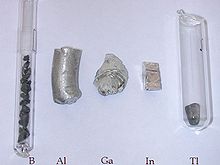
The five stable elements of the boron group
| Element | Humid Betoken | Density (g/cm3) |
|---|---|---|
| Boron | 4,000°C | 2.46 |
| Aluminium | 2,519°C | 2.7 |
| Gallium | ii,204°C | v.904 |
| Indium | 2,072°C | seven.31 |
| Thallium | i,473°C | 11.85 |
Nuclear [edit]
With the exception of the synthetic nihonium, all of the elements of the boron grouping have stable isotopes. Considering all their diminutive numbers are odd, boron, gallium and thallium take simply 2 stable isotopes, while aluminium and indium are monoisotopic, having but 1, although most indium institute in nature is the weakly radioactive 115In. 10B and 11B are both stable, as are 27Al, 69Ga and 71Ga, 113In, and 203Tl and 205Tl.[24] All of these isotopes are readily found in macroscopic quantities in nature. In theory, though, all isotopes with an atomic number greater than 66 are supposed to be unstable to alpha decay. Conversely, all elements with diminutive numbers are less than or equal to 66 (except Tc, Pm, Sm and Eu) have at least one isotope that is theoretically energetically stable to all forms of decay (with the exception of proton decay, which has never been observed, and spontaneous fission, which is theoretically possible for elements with diminutive numbers greater than 40).
Like all other elements, the elements of the boron grouping have radioactive isotopes, either found in trace quantities in nature or produced synthetically. The longest-lived of these unstable isotopes is the indium isotope 115In, with its extremely long half-life of four.41 × 1014 y. This isotope makes upward the vast majority of all naturally occurring indium despite its slight radioactivity. The shortest-lived is 7B, with a half-life of a mere 350±50 × 10−24 southward, being the boron isotope with the fewest neutrons and a half-life long enough to mensurate. Some radioisotopes take important roles in scientific research; a few are used in the production of goods for commercial employ or, more rarely, as a component of finished products.[25]
History [edit]
The boron group has had many names over the years. According to onetime conventions it was Group IIIB in the European naming system and Group IIIA in the American. The grouping has also gained two collective names, "earth metals" and "triels". The latter name is derived from the Latin prefix tri- ("3") and refers to the 3 valence electrons that all of these elements, without exception, have in their valence shells.[1]
Boron was known to the ancient Egyptians, but only in the mineral borax. The metalloid element was not known in its pure course until 1808, when Humphry Davy was able to excerpt it by the method of electrolysis. Davy devised an experiment in which he dissolved a boron-containing chemical compound in water and sent an electric current through information technology, causing the elements of the compound to separate into their pure states. To produce larger quantities he shifted from electrolysis to reduction with sodium. Davy named the element boracium. At the same time two French chemists, Joseph Louis Gay-Lussac and Louis Jacques Thénard, used iron to reduce boric acrid. The boron they produced was oxidized to boron oxide.[26] [27]
Aluminium, like boron, was first known in minerals before information technology was finally extracted from alum, a common mineral in some areas of the earth. Antoine Lavoisier and Humphry Davy had each separately tried to extract it. Although neither succeeded, Davy had given the metal its current name. It was only in 1825 that the Danish scientist Hans Christian Ørsted successfully prepared a rather impure course of the element. Many improvements followed, a significant accelerate being made merely ii years later by Friedrich Wöhler, whose slightly modified process nonetheless yielded an impure product. The offset pure sample of aluminium is credited to Henri Etienne Sainte-Claire Deville, who substituted sodium for potassium in the procedure. At that time aluminium was considered precious, and it was displayed adjacent to such metals as gold and silverish.[27] [28] The method used today, electrolysis of aluminium oxide dissolved in cryolite, was developed by Charles Martin Hall and Paul Héroult in the late 1880s.[27]

The mineral zinc blende, more commonly known every bit sphalerite, in which indium can occur.
Thallium, the heaviest stable element in the boron grouping, was discovered by William Crookes and Claude-Auguste Lamy in 1861. Unlike gallium and indium, thallium had not been predicted by Dmitri Mendeleev, having been discovered before Mendeleev invented the periodic table. As a effect, no one was actually looking for it until the 1850s when Crookes and Lamy were examining residues from sulfuric acrid production. In the spectra they saw a completely new line, a streak of deep green, which Crookes named later the Greek word θαλλός ( thallos ), referring to a green shoot or twig. Lamy was able to produce larger amounts of the new metallic and determined most of its chemical and physical backdrop.[29] [xxx]
Indium is the fourth chemical element of the boron group but was discovered before the 3rd, gallium, and afterward the fifth, thallium. In 1863 Ferdinand Reich and his assistant, Hieronymous Theodor Richter, were looking in a sample of the mineral zinc blende, also known as sphalerite (ZnS), for the spectroscopic lines of the newly discovered element thallium. Reich heated the ore in a scroll of platinum metal and observed the lines that appeared in a spectroscope. Instead of the light-green thallium lines that he expected, he saw a new line of deep indigo-blue. Final that it must come from a new element, they named it afterwards the characteristic indigo color information technology had produced.[29] [31]
Gallium minerals were not known earlier August 1875, when the element itself was discovered. It was one of the elements that the inventor of the periodic table, Dmitri Mendeleev, had predicted to exist six years before. While examining the spectroscopic lines in zinc blende the French chemist Paul Emile Lecoq de Boisbaudran found indications of a new element in the ore. In just iii months he was able to produce a sample, which he purified past dissolving it in a potassium hydroxide (KOH) solution and sending an electrical electric current through it. The side by side month he presented his findings to the French University of Sciences, naming the new chemical element later the Greek proper noun for Gaul, modern France.[32] [33]
The last confirmed element in the boron group, nihonium, was not discovered merely rather created or synthesized. The element'southward synthesis was outset reported by the Dubna Articulation Institute for Nuclear Inquiry team in Russia and the Lawrence Livermore National Laboratory in the United States, though information technology was the Dubna team who successfully conducted the experiment in August 2003. Nihonium was discovered in the decay concatenation of moscovium, which produced a few precious atoms of nihonium. The results were published in January of the post-obit yr. Since then effectually thirteen atoms have been synthesized and diverse isotopes characterized. However, their results did not meet the stringent criteria for being counted as a discovery, and it was the afterward RIKEN experiments of 2004 aimed at directly synthesizing nihonium that were best-selling by IUPAC every bit the discovery.[34]
Etymology [edit]
The name "boron" comes from the Arabic discussion for the mineral borax,(بورق, boraq) which was known before boron was always extracted. The "-on" suffix is thought to have been taken from "carbon".[35] Aluminium was named by Humphry Davy in the early 1800s. It is derived from the Greek word alumen, pregnant bitter salt, or the Latin alum, the mineral.[36] Gallium is derived from the Latin Gallia, referring to French republic, the place of its discovery.[37] Indium comes from the Latin word indicum, meaning indigo dye, and refers to the element's prominent indigo spectroscopic line.[38] Thallium, similar indium, is named after the Greek give-and-take for the color of its spectroscopic line: thallos , pregnant a greenish twig or shoot.[39] [twoscore] "Nihonium" is named after Japan (Nihon in Japanese), where information technology was discovered.
Occurrence and abundance [edit]
Boron [edit]
Boron, with its atomic number of v, is a very light element. Nigh never found free in nature, information technology is very low in abundance, composing only 0.001% (10 ppm)[41] of the Earth's chaff. It is known to occur in over a hundred different minerals and ores, however: the main source is borax, simply information technology is likewise found in colemanite, boracite, kernite, tusionite, berborite and fluoborite.[42] Major world miners and extractors of boron include Turkey, the United States, Argentine republic, China, Bolivia and Republic of peru. Turkey is by far the almost prominent of these, accounting for around 70% of all boron extraction in the world. The U.s.a. is second, well-nigh of its yield coming from the country of California.[43]
Aluminium [edit]
Aluminium, in contrast to boron, is the virtually abundant metallic in the Earth's crust, and the tertiary nearly abundant chemical element. It composes about viii.2% (82,000 ppm) of the Earth's crust, surpassed simply by oxygen and silicon.[41] It is like boron, nonetheless, in that it is uncommon in nature as a free element. This is due to aluminium'south tendency to attract oxygen atoms, forming several aluminium oxides. Aluminium is now known to occur in nearly every bit many minerals as boron, including garnets, turquoises and beryls, but the principal source is the ore bauxite. The world'due south leading countries in the extraction of aluminium are Republic of ghana, Surinam, Russia and Indonesia, followed by Australia, Republic of guinea and Brazil.[44]
Gallium [edit]
Gallium is a relatively rare chemical element in the Earth'southward chaff and is not establish in every bit many minerals equally its lighter homologues. Its affluence on the Earth is a mere 0.0018% (18 ppm).[41] Its production is very low compared to other elements, but has increased greatly over the years as extraction methods have improved. Gallium can be constitute as a trace in a variety of ores, including bauxite and sphalerite, and in such minerals equally diaspore and germanite. Trace amounts have been found in coal as well.[45] The gallium content is greater in a few minerals, including gallite (CuGaS2), but these are too rare to be counted as major sources and make negligible contributions to the world's supply.
Indium [edit]
Indium is another rare element in the boron group. Even less arable than gallium at only 0.000005% (0.05 ppm),[41] it is the 61st most mutual chemical element in the world's crust. Very few indium-containing minerals are known, all of them scarce: an example is indite. Indium is constitute in several zinc ores, but simply in infinitesimal quantities; likewise some copper and pb ores incorporate traces. As is the case for most other elements institute in ores and minerals, the indium extraction procedure has get more efficient in recent years, ultimately leading to larger yields. Canada is the world'southward leader in indium reserves, only both the Usa and Red china accept comparable amounts.[46]
Thallium [edit]

A small bundle of fiberglass
Thallium is of intermediate affluence in the Earth's chaff, estimated to be 0.00006% (0.6 ppm).[41] Thallium is the 56th most mutual element in the world's crust, more arable than indium by a sizeable corporeality. It is found on the ground in some rocks, in the soil and in clay. Many sulfide ores of iron, zinc and cobalt contain thallium. In minerals information technology is found in moderate quantities: some examples are crookesite (in which it was first discovered), lorandite, routhierite, bukovite, hutchinsonite and sabatierite. There are other minerals that contain small amounts of thallium, but they are very rare and do not serve equally chief sources.
Nihonium [edit]
Nihonium is an chemical element that is never found in nature but has been created in a laboratory. It is therefore classified as a synthetic chemical element with no stable isotopes.
Applications [edit]
With the exception of constructed nihonium, all the elements in the boron group have numerous uses and applications in the product and content of many items.
Boron [edit]
Boron has found many industrial applications in recent decades, and new ones are however existence found. A common application is in fiberglass.[47] There has been rapid expansion in the marketplace for borosilicate drinking glass; most notable among its special qualities is a much greater resistance to thermal expansion than regular drinking glass. Another commercially expanding use of boron and its derivatives is in ceramics. Several boron compounds, especially the oxides, have unique and valuable backdrop that have led to their substitution for other materials that are less useful. Boron may be found in pots, vases, plates, and ceramic pan-handles for its insulating properties.
The chemical compound borax is used in bleaches, for both clothes and teeth. The hardness of boron and some of its compounds requite it a wide array of additional uses. A small part (5%) of the boron produced finds use in agriculture.[47]
Aluminium [edit]
Aluminium is a metallic with numerous familiar uses in everyday life. It is about often encountered in construction materials, in electrical devices, especially as the usher in cables, and in tools and vessels for cooking and preserving nutrient. Aluminium'due south lack of reactivity with food products makes information technology particularly useful for canning. Its high analogousness for oxygen makes it a powerful reducing agent. Finely powdered pure aluminium oxidizes rapidly in air, generating a huge amount of heat in the process (burning at about 5500 °F or 3037 °C), leading to applications in welding and elsewhere that a large amount of heat is needed. Aluminium is a component of alloys used for making lightweight bodies for aircraft. Cars as well sometimes incorporate aluminium in their framework and body, and there are similar applications in military equipment. Less common uses include components of decorations and some guitars. The element is also sees employ in a various range of electronics.[48] [49]
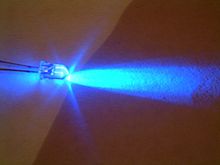
Gallium is one of the main components of bluish LEDs
Gallium [edit]
Gallium and its derivatives have only found applications in recent decades. Gallium arsenide has been used in semiconductors, in amplifiers, in solar cells (for example in satellites) and in tunnel diodes for FM transmitter circuits. Gallium alloys are used mostly for dental purposes. Gallium ammonium chloride is used for the leads in transistors.[fifty] A major application of gallium is in LED lighting. The pure element has been used as a dopant in semiconductors,[ citation needed ] and has additional uses in electronic devices with other elements. Gallium has the property of being able to 'wet' glass and porcelain, and thus tin can be used to make mirrors and other highly reflective objects. Gallium can be added to alloys of other metals to lower their melting points.
Indium [edit]
Indium's uses can be divided into four categories: the largest part (70%) of the production is used for coatings, usually combined as indium tin oxide (ITO); a smaller portion (12%) goes into alloys and solders; a similar amount is used in electric components and in semiconductors; and the final 6% goes to small-scale applications.[51] Among the items in which indium may exist plant are platings, bearings, display devices, heat reflectors, phosphors, and nuclear control rods. Indium tin oxide has found a wide range of applications, including glass coatings, solar panels, streetlights, electrophosetic displays (EPDs), electroluminescent displays (ELDs), plasma brandish panels (PDPs), electrochemic displays (ECs), field emission displays (FEDs), sodium lamps, windshield glass and cathode ray tubes, making it the single virtually important indium compound.[52]
Thallium [edit]
Thallium is used in its elemental form more often than the other boron-group elements. Uncompounded thallium is used in low-melting glasses, photoelectric cells, switches, mercury alloys for depression-range glass thermometers, and thallium salts. It can be found in lamps and electronics, and is also used in myocardial imaging. The possibility of using thallium in semiconductors has been researched, and it is a known goad in organic synthesis. Thallium hydroxide (TlOH) is used mainly in the production of other thallium compounds. Thallium sulfate (Tl2And then4) is an outstanding vermin-killer, and it is a principal component in some rat and mouse poisons. Even so, the United states and some European countries accept banned the substance considering of its high toxicity to humans. In other countries, though, the market for the substance is growing. Tl2SOiv is likewise used in optical systems.[53]
Biological role [edit]
None of the group-13 elements has a major biological role in complex animals, only some are at least associated with a living being. As in other groups, the lighter elements usually accept more biological roles than the heavier. The heaviest ones are toxic, as are the other elements in the aforementioned periods. Boron is essential in almost plants, whose cells employ information technology for such purposes as strengthening cell walls. Information technology is found in humans, certainly equally a essential trace element, but there is ongoing debate over its significance in human being nutrition. Boron's chemistry does allow it to form complexes with such of import molecules equally carbohydrates, and so it is plausible that information technology could be of greater employ in the homo trunk than previously idea. Boron has also been shown to exist able to replace atomic number 26 in some of its functions, particularly in the healing of wounds.[54] Aluminium has no known biological role in plants or animals. Gallium is not essential for the human torso, only its relation to iron(Three) allows information technology to become jump to proteins that transport and store iron.[55] Gallium tin can also stimulate metabolism. Indium and its heavier homologues have no biological role, although indium salts in small doses, like gallium, can stimulate metabolism.[31]
Toxicity [edit]
All of the elements in the boron group can be toxic, given a high enough dose. Some of them are but toxic to plants, some just to animals, and some to both.
As an example of boron toxicity, information technology has been observed to impairment barley in concentrations exceeding 20 mM.[56] The symptoms of boron toxicity are numerous in plants, complicating research: they include reduced prison cell sectionalization, decreased shoot and root growth, decreased production of leaf chlorophyll, inhibition of photosynthesis, lowering of stomata conductance, reduced proton extrusion from roots, and deposition of lignin and suborgin.[57]
Aluminium does non present a prominent toxicity hazard in minor quantities, only very large doses are slightly toxic. Gallium is not considered toxic, although information technology may take some modest effects. Indium is non toxic and can be handled with nearly the same precautions as gallium, only some of its compounds are slightly to moderately toxic.
Thallium, unlike gallium and indium, is extremely toxic, and has caused many poisoning deaths. Its virtually noticeable effect, apparent even from tiny doses, is pilus loss all over the body, but it causes a wide range of other symptoms, disrupting and eventually halting the functions of many organs. The virtually colorless, odorless and tasteless nature of thallium compounds has led to their use by murderers. The incidence of thallium poisoning, intentional and accidental, increased when thallium (with its similarly toxic compound, thallium sulfate) was introduced to control rats and other pests. The use of thallium pesticides has therefore been prohibited since 1975 in many countries, including the USA.
Nihonium is a highly unstable element and decays by emitting alpha particles. Due to its strong radioactivity, it would definitely exist extremely toxic, although meaning quantities of nihonium (larger than a few atoms) have not notwithstanding been assembled.[58]
Notes [edit]
- ^ The name icosagens for grouping 13 has occasionally been used,[2] in reference to the icosahedral structures characteristically formed by its elements.
- ^ To this date, no nihonium compounds have been synthesized (except possibly NhOH), and all other proposed compounds are entirely theoretical.
References [edit]
- ^ a b Kotz, John C.; Treichel, Paul & Townsend, John Raymond (2009). Chemistry and chemical reactivity. Vol. 2. Belmont, Ca, Usa: Thomson Books. p. 351. ISBN978-0-495-38712-1.
- ^ Greenwood, Norman Northward.; Earnshaw, Alan (1997). Chemical science of the Elements (second ed.). Butterworth-Heinemann. p. 227. ISBN978-0-08-037941-8.
- ^ "Soviet Aluminium from Clay". New Scientist. One Shilling Weekly. 8 (191): 89. 1960.
- ^ Pharmacology and Nutritional Intervention in the Treatment of Disease edited by Faik Atroshi, page 45
- ^ Dobbs, Michael (2009). Clinical neurotoxicology: syndromes, substances, environments. Philadelphia, Pa: Saunders. pp. 276–278. ISBN978-0-323-05260-iii.
- ^ a b c Harding, A., Charlie; Johnson, David; Janes, Rob (2002). Elements of the p block. Cambridge, UK: The Open University. p. 113. ISBN0-85404-690-9.
- ^ Raghavan, P. Due south. (1998). Concepts And Problems In Inorganic Chemical science. New Delhi, Bharat: Discovery Publishing Business firm. p. 43. ISBN81-7141-418-four.
- ^ Cole, M. Fifty.; Hibbs, D. E.; Jones, C.; Smithies, N. A. (2000). "Phosphine and phosphido indium hydride complexes and their use in inorganic synthesis". Journal of the Chemic Order, Dalton Transactions (4): 545–550. doi:10.1039/A908418E.
- ^ a b Downs, pp. 197–201
- ^ Daintith, John (2004). Oxford dictionary of chemistry. Market place Firm Books. ISBN978-0-19-860918-6.
- ^ Bleshinsky, S. V.; Abramova, 5. F. (1958). Химия индия (in Russian). Frunze. p. 301.
- ^ Downs, pp. 195–196
- ^ Henderson, p. 6
- ^ Jellison, Thou. Due east.; Panek, Fifty. W.; Bray, P. J.; Rouse, Grand. B. (1977). "Determinations of structure and bonding in vitreous B2O3 by ways of B10, B11, and O17 NMR". The Journal of Chemic Physics. 66 (ii): 802. Bibcode:1977JChPh..66..802J. doi:x.1063/1.433959. Retrieved June 16, 2011.
- ^ Henderson, p. 60
- ^ Young, J. P.; Haire, R. G.; Peterson, J. R.; Ensor, D. D.; Fellow, R. L. (1981). "Chemic Consequences of Radioactive decay. ii. Spectrophotometric Study of the Ingrowth of Berkelium-249 and Californium-249 Into Halides of Einsteinium-253". Inorganic Chemistry. 20 (xi): 3979–3983. doi:x.1021/ic50225a076.
- ^ Francis, William (1918). "The Chemical Gazette, or Journal of Practical Chemistry". XVI. Boston, Ma: 269.
- ^ Roza, Greg (2010). The Halogen Elements: Fluorine, Chlorine, Bromine, Iodine, Astatine. NY, New York, USA: The Rozen Publishing Grouping, Inc. p. 33. ISBN978-1-4358-3556-half dozen.
- ^ Girard, James Due east. (2010). Criminalistics: Forensic Science, Criminal offence and Terrorism. Jones & Bartlett Learning. p. 221. ISBN978-0-7637-7731-9.
- ^ Henderson, p. 57
- ^ Barrett, Jack (2001). Structure and bonding. Cambridge, UK: The Royal Society of Chemistry. p. 91. ISBN0-85404-647-X.
- ^ Protchenko, Andrey 5.; Dange, Deepak; Harmer, Jeffrey R.; Tang, Christina Y.; Schwarz, Andrew D.; Kelly, Michael J.; Phillips, Nicholas; Tirfoin, Remi; Birjkumar, Krishna Hassomal; Jones, Cameron; Kaltsoyannis, Nikolas; Mountford, Philip; Aldridge, Simon (16 Feb 2014). "Stable GaX2, InX2 and TlX2 radicals". Nature Chemistry. 6 (4): 315–319. Bibcode:2014NatCh...6..315P. doi:10.1038/nchem.1870. PMID 24651198.
- ^ Haire, Richard Thousand. (2006). "Transactinides and the future elements". In Morss; Edelstein, Norman Chiliad.; Fuger, Jean (eds.). The Chemistry of the Actinide and Transactinide Elements (tertiary ed.). Dordrecht, The Netherlands: Springer Scientific discipline+Business organization Media. ISBNi-4020-3555-ane.
- ^ Aldridge, Simon; Downs, Anthony J.; Downs, Tony (2011). The Group xiii Metals Aluminium, Gallium, Indium and Thallium: Chemical Patterns and Peculiarities. John Wiley & Sons. p. ii. ISBN978-0-470-68191-6.
- ^ Downs, pp. nineteen–24
- ^ Krebs, Robert E. (2006). The History and Employ of Our Earth's Chemic Elements: A Reference Guide. Greenwood Press. p. 176. ISBN978-0-313-33438-2.
- ^ a b c Weeks, Mary Elvira (1932). "The discovery of the elements. XII. Other elements isolated with the aid of potassium and sodium: Beryllium, boron, silicon, and aluminium". Periodical of Chemic Pedagogy. 9 (8): 1386. Bibcode:1932JChEd...ix.1386W. doi:10.1021/ed009p1386.
- ^ Downs, p. 15
- ^ a b Weeks, Mary Elvira (1932). "The discovery of the elements. XIII. Some spectroscopic discoveries". Journal of Chemical Education. nine (8): 1413. Bibcode:1932JChEd...ix.1413W. doi:10.1021/ed009p1413.
- ^ Enghag, Per (2004). Encyclopedia of the elements: technical information, history, processing, applications. p. 71. Bibcode:2004eetd.volume.....Eastward. ISBN978-three-527-30666-4.
- ^ a b Emsley, p. 192
- ^ Emsley, pp. 158–159
- ^ Weeks, Mary Elvira (1932). "The discovery of the elements. Xv. Some elements predicted by Mendeleeff". Journal of Chemic Education. 9 (9): 1605–1619. Bibcode:1932JChEd...9.1605W. doi:10.1021/ed009p1605.
- ^ Oganessian, Yu. Ts.; Utyonkoy, Five.; Lobanov, Yu.; Abdullin, F.; Polyakov, A.; Shirokovsky, I.; Tsyganov, Yu.; Gulbekian, G.; Bogomolov, S. (2004). "Experiments on the synthesis of element 115 in the reaction 243Am(48Ca,xn)291−x115" (PDF). Physical Review C. 69 (ii): 021601. Bibcode:2004PhRvC..69b1601O. doi:x.1103/PhysRevC.69.021601.
- ^ Lavrova, Natalie (2010). Discussion-Building Strategies in Mod English. Germany: GRIN Verlag. p. 95. ISBN978-3-640-53719-8.
- ^ Bugarski, Ranko (2000). Tomić, Olga Mišeska; Milorad, Radovanović (eds.). History and perspectives of language study. Amsterdam, kingdom of the netherlands: John Benjamins Publishing Co. p. 211. ISBN90-272-3692-5.
- ^ Weeks, Mary Elvira (1932). "The discovery of the elements. Thirteen. Some elements predicted by Mendeleeff". Periodical of Chemical Education. 9 (9): 1605–1619. Bibcode:1932JChEd...9.1605W. doi:10.1021/ed009p1605.
- ^ Venetskii, Southward. (1971). "Indium". Metallurgist. 15 (2): 148–150. doi:10.1007/BF01088126.
- ^ Harper, Douglas. "thallium". Online Etymology Dictionary.
- ^ Weeks, Mary Elvira (1932). "The discovery of the elements. XIII. Supplementary annotation on the discovery of thallium". Journal of Chemical Education. nine (12): 2078. Bibcode:1932JChEd...9.2078W. doi:10.1021/ed009p2078.
- ^ a b c d e Kotz, John C.; Treichel, Paul & Townsend, John Raymond (2009). Chemistry and chemical reactivity. Vol. two. Belmont, Ca, The states: Thomson Books. p. 979. ISBN978-0-495-38712-1.
- ^ Klein, Cornelis and Hurlbut, Cornelius Jr. (1985) Manual of Mineralogy, Wiley, 20th ed., pp. 343–347, ISBN 0-471-80580-7
- ^ Zbayolu, G.; Poslu, Chiliad. (1992). "Mining and Processing of Borates in Turkey". Mineral Processing and Extractive Metallurgy Review. 9 (one–4): 245–254. doi:10.1080/08827509208952709.
- ^ Emsley, pp. 22–26
- ^ Shan Xiao-quan; Wang Wen & Wen Bei (1992). "Decision of gallium in coal and coal fly ash by electrothermal atomic absorption spectrometry using slurry sampling and nickel chemical modification". Journal of Belittling Atomic Spectrometry. 7 (5): 761. doi:x.1039/JA9920700761.
- ^ Schwarz-Schampera, Ulrich; K. Herzig; Peter; für Geowissenschaften & Rohstoffe, Bundesanstalt (2002). Indium: geology, mineralogy, and economic science. Berlin, Deutschland: Springer-Verlag. p. 161. ISBNiii-540-43135-seven.
- ^ a b Roesky, H.W.; Atwood, David A. (2003). Grouping 13 chemistry Three: industrial applications. Berlin, Germany: Springer-Verlag. pp. iii–10. ISBN3-540-44105-0.
- ^ Gregory, J. W. (2004). the elements of economic geology. Taylor & Francis. p. 152.
- ^ Chatterjee, G. Thou. (2007). Uses Of Metals And Metal Minerals. New Age International. p. 9. ISBN978-81-224-2040-1.
- ^ Chandler, Harry (1998). Metallurgy for the non-metallurgist. ASM International. p. 59. ISBN0-87170-652-0.
- ^ US Department of the Interior (2007). Minerals Yearbook: Metals And Minerals; 2005. Washington, DC: US Government Printing Role. pp. 36–one. ISBN978-ane-4113-1980-half-dozen.
- ^ Schwarz-Schampera, Ulrich; M. Herzig, Peter; für Geowissenschaften und Rohstoffe, Bundesanstal (2002). Indium: geology, mineralogy, and economics. Berlin, Germany: Springer-Verlag. p. 169. ISBNiii-540-43135-7.
- ^ Mager, Jeanne (1998). Encyclopaedia of Occupational Health and Safety. Geneva, Switzerland: International Labor Organization Publications. p. section 63.xl. ISBN978-92-2-109816-iv.
- ^ Reilly, Conor (2004). The nutritional trace metals. Ames, Iowa: Blackwell Publishing. p. 217. ISBNane-4051-1040-6.
- ^ Crichton, Robert R. (2008). Biological inorganic chemistry: an introduction. UK. p. 9. ISBN978-0-444-52740-0.
- ^ Fangsen, Xu (2007). Advances in plant and animal boron diet. Dordrecht, Netherlands: Springer. p. 84. ISBN978-1-4020-5382-5.
- ^ Lovatt, Ballad J.; Bates, Loretta Yard. (1984). "Early on effects of excess boron on photosynthesis and growth". Periodical of Experimental Botany. 35 (iii): 297–305. doi:10.1093/jxb/35.3.297.
- ^ Dobbs, Michael (2009). Clinical neurotoxicology: syndromes, substances, environments. Philadelphia: Saunders. p. 277. ISBN978-0-323-05260-iii.
Bibliography [edit]
- Downs, Anthony John (1993). Chemistry of aluminium, gallium, indium, and thallium. Chapman and Hall Inc. pp. 197–201. ISBN978-0-7514-0103-five.
- Emsley, John (2006). Nature's building blocks: an A-Z guide to the elements. Greenwood Press. p. 192. ISBN978-0-xix-850340-viii.
- Henderson, W. (2000). Principal group chemical science. Cambridge, UK: The Royal Order of Chemistry. p. six. ISBN0-85404-617-eight.
External links [edit]
- oxide (chemical compound) – Britannica Online Encyclopedia. Britannica.com. Retrieved on 2011-05-16.
- Visual Elements: Group 13. Rsc.org. Retrieved on 2011-05-16.
- Trends In Chemical Reactivity Of Grouping 13 Elements. Tutorvista.com. Retrieved on 2011-05-16.
- [1] etymonline.com Retrieved on 2011-07-27
Source: https://en.wikipedia.org/wiki/Boron_group
0 Response to "A Member of the Boron Family Has Three Valence Electrons, While a Member of the Carbon Family Has"
Post a Comment