He Highlighted the Undesirable Nature of the Contemporary Art Critic
What is Contemporary Art
The substitution of ideas presents 1 of the brightest features of the humanity that make us different from animals living on our planet. The urgent need of cocky-expression appeared when homo brain was adult enough to create something that he had never seen, and information technology became an essential condition for future development of different forms of art. Speaking about art, we usually mean a broad range of activities that are aimed at creating new objects.i Unlike scientific inventions, the objects of art are not created to extend the cognition virtually the world and the laws of nature; instead, they usually assist the creative person to convey certain message and express his attitude towards many things happening in the world. Information technology is against this background that art is impossible to supersede equally it presents a manner of communication that allows people living in dissimilar countries and having different cultural background speak the aforementioned language, the 1 that does not require using words to be understood.
It is interesting that people's opinion about art tends to be different when it comes to its historical periods. Looking at the paintings, sculptures, and mosaic inlays created many centuries ago, many people seem to be really impressed although these pieces of fine art are unremarkably connected to the themes that are not currently fundamental in the mod human society. In the past, much attention of an creative person was paid to the technique and working out the tiniest details of an object of art. In the last centuries, the people of art were working hard to set the standards that would determine people's taste.2 Having taken a look at contemporary art and its peculiarities, i can find out that, to some extent, it presents the very opposite of the classical period in the field of art.3 Those artists who were working that period were setting standards whereas gimmicky art seems to exist aimed at abandoning whatsoever standards.
Contemporary art is proclaiming the idea that existent works of art cannot be created if there are certain rules that have to be followed, and the artist has no risk to develop his talent if he does not feel free from conventionality. Speaking about contemporary art, people usually mean the objects of fine art and artistic techniques that began to exist used in the heart of the twentieth century. Contemporary art may exist classified as the field that has no stiff connection to the composition rules peculiar for classic art.iv Ane of the most distinctive features of contemporary fine art is its striving for multifariousness; within its frames, it becomes possible to employ all the ways that 1 can imagine to convey the message. In many cases, the objects of contemporary art present the manner to vocalism the artist's protestation confronting the meaning statements made by political leaders such as decisions to dig up the tomahawk or choosing a new political or economical direction. The objects of art created by our contemporaries tend to reverberate the modern society in its truthful colors.
Besides, it frequently happens that contemporary artists show numerous diseases of the humanity in an exaggerated fashion or in a style carrying the depicted trouble to the point of absurdity. Taking that into consideration, information technology is possible to conclude that contemporary fine art is something more than just creation of objects that look practiced to the viewer's eye.5 On the contrary, information technology often involves transforming the urgent issues of our lodge into visual images that are able to brand people take notice of things that they unremarkably attach petty importance to, and such arroyo to making people more conscious seems to exist an effective tool for struggling with homo ignorance.6 The contemporary fine art customs is full of many famous artists developing their own styles; they are then different that they seem to be united only by their passion to art.7 Existence a part of this community, Ai Weiwei from People's republic of china and Richard Prince from the The states vest to the number of the artists whose works crusade unlike reactions ranging from excitement to anger.
Ai Weiwei: The Creative person Who Confronts Chinese Officials
Ai Weiwei is one of the near famous contemporary artists from China, he works in the fields of painting and architecture. This artist is believed to be one of the most dominant figures in the earth of art. At the same time, he is regarded as a man with an ambiguous character. Due to his unwillingness to proceed silent if he knows something and believes that is has to become a public noesis, Ai Weiwei is usually regarded as a notorious person. In spite of his great financial possibilities and his having skilful friends in the correct places, his life is full of fear as his works of art and projects frequently incur a displeasure of the Chinese officials. He has been a member of many associations of artists such as "The Stars" that was a motility proclaiming the ideas of the importance of individualism and contradicting the canons of Chinese art.
To the members of this art group, the traditional theory of art seemed to be a prison preventing people from free self-expression and developing their talents. Their works contained many details showing the authors' critical attitude towards Chinese officials holding the reins of power in the end of the twentieth century. Throughout its existence, this art group created many works showing the authors' dissent from an opinion expressed by the authorities. One of the most famous works created by the grouping was a wooden head with closed optics and a oral fissure gag that represented the authors' opinion on a freedom of spoken communication in China. The group arranged ii exhibitions and all the works presented there were expressing a growing discontent with the political system in Prc and the officials' opinions on human rights and liberty of utterance.
What is more, they seemed to become over the line equally their works were presenting a strong statement confronting traditional Chinese civilisation. The public response to these exhibitions was quite easy to predict. Despite many negative consequences that these exhibitions caused, the activity of this fine art grouping is believed to take paved the way for the revolution in Chinese art. Nowadays, Ai Weiwei is the nigh famous participant of this art group. Creating his art works, he does non care virtually the reaction that they may cause, and due to this readiness to trigger a discontent of the government he is not allowed to exit Cathay.
The Most Famous Works by Ai Weiwei and their Meaning
Ai Weiwei has been a member of many fine art groups merely in general, he is known for his individual fine art works. Besides existence an artist, he is a political activist, and he has to pay a loftier price for his striving for the truth. For instance, he is known for his attempts to investigate the instance of Sichuan earthquake that happened eight years ago. As a effect, he institute out a lot of information that was new for the majority of mutual people. When he wanted to support a champion of homo rights who wanted to unmask the mistakes of the assistants of Sichuan, he was beaten up by Chinese constabulary officers. Having taken this into consideration, it is like shooting fish in a barrel to imagine the magnitude of his conflict with Chinese public authorities.
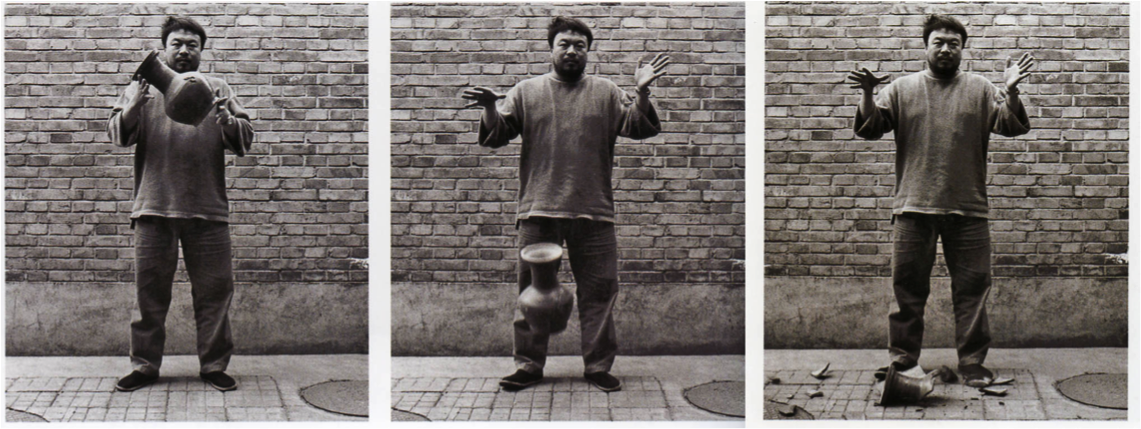
In general, his fine art touches upon the topic of present political grade of China and its consequences. In the end of the twentieth century, Ai Weiwei started using elements of traditional Chinese fine art in his works. The affair that caused a lot of discontent is that he was non using Chinese motives in order to evidence his respect for the cultural heritage of his ancestors. Instead, he seemed to be trying to express mirth at those people who identify themselves with Chinese traditional civilisation. This topic is very controversial; that period, his artistic activeness verged on cultural violence and insanity. For example, to create i of his fine art projects, he had to destroy one of the ancient Chinese urns. The photo is chosen Dropping a Han Dynasty Urn, 1995 (fig.1).
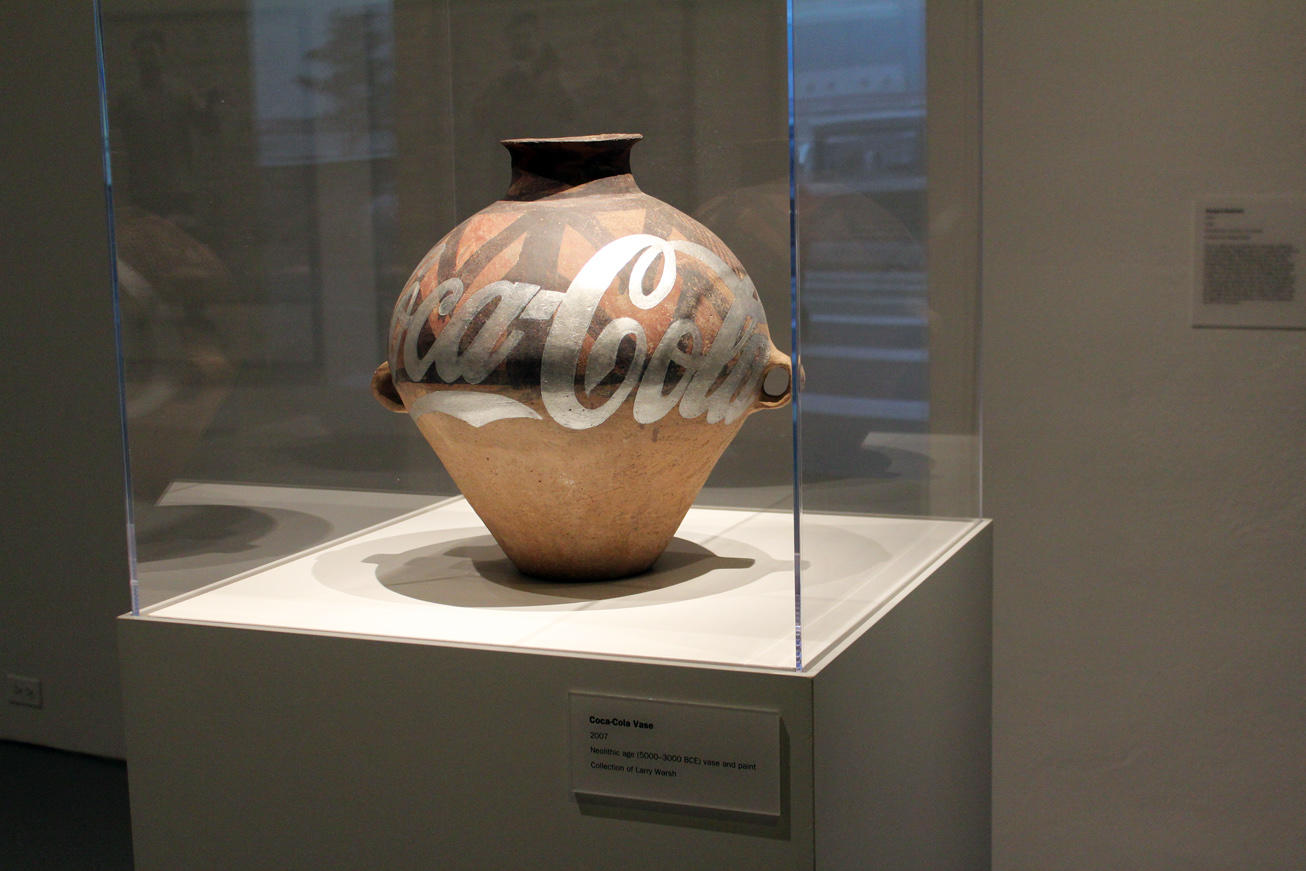
To limited his attitude towards the order of preferences concerning art, and distinguish himself from the crowd of other artists, he changed the design of i of the Han dynasty urns by drawing on it a logo of Coca Cola company (fig.ii).
However, he cannot be regarded as a person who does not have any respect to the traditions of his nation. The distinctive features of Chinese civilization were used past him in guild to create something new that would bridge the gap between traditional and revolutionary views on art. To bear witness how these two contrary approaches may coexist, he developed a project that presented a slap-up construction consisting of archaicized vases. He is known as a person who tries to use everything material that tin can exist turned into an art object. Thus, trying to wait beyond the frame and create something that has no analogues in the globe, he constructed an art object consisting of parts of a one thousand bicycles (fig.3).
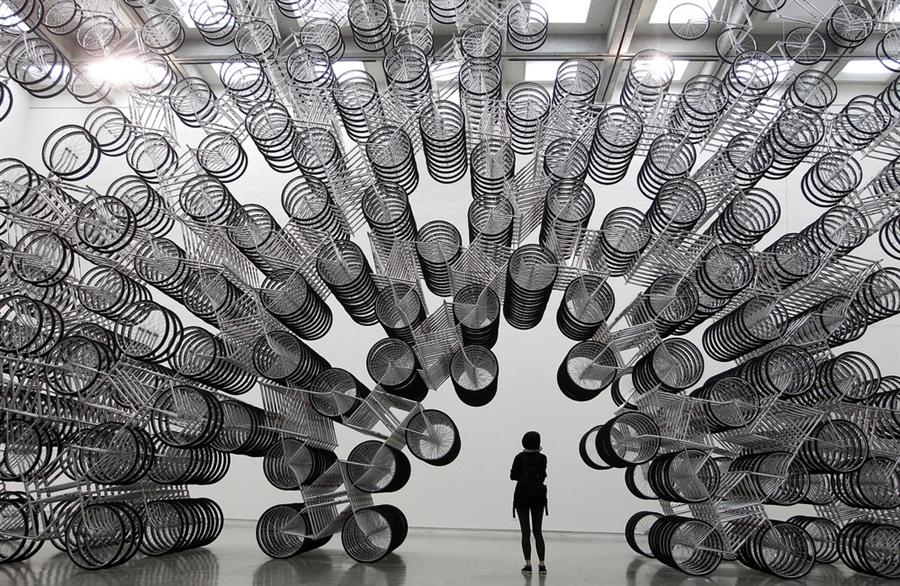
The creative person's pick of the fabric seems to reflect the facts of life in China, equally many people living in that location prefer to ride a bicycle instead of using public transport. To some extent, this installation tin can exist regarded as a monument to movement that helps people to stay alive and experience ameliorate. Worldmap is one of the most unusual fine art works created by Ai Weiwei. This piece of fine art consists of two thousand layers of white fabric, and the shape of unlike continents of the Globe is cut out from this fabric. This very work presents Ai Weiwei'due south opinion on present status of his country in the world (fig.four).
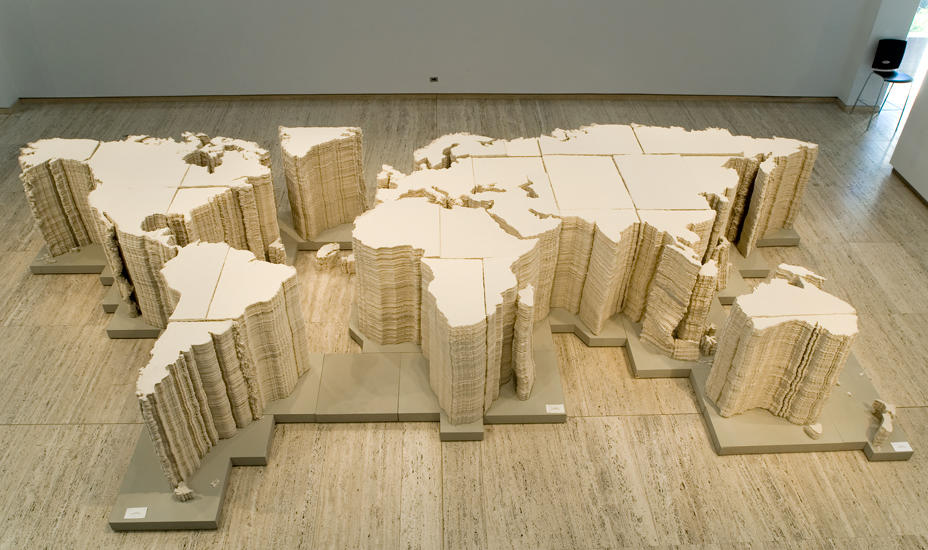
During the creation of this object of art, many Chinese volunteers were helping Ai Weiwei. By means of this projection, the creative person wanted to highlight the way that the globe community sees China. The work symbolizes China's being one of the countries with the cheapest labor force in the spheres of textile industry and fabrication. Political and economic contexts seem to be reflected in Ai Weiwei's fine art practices very oftentimes; more chiefly, he managed to turn himself into a symbol of liberty of speech communication and a struggle against the authorities. Although many people believe him to exist a person who is simply trying to concenter an attention of a society, he definitely belongs to the number of people who contribute into the development of Chinese art.
Richard Prince: An Artist or a Thief?
Richard Prince is ane of the near famous members of the contemporary art community of the United States. As a child, Prince lived in United States and in Groovy Britain. Having graduated from the academy, he started working for a publishing company. In the finish of 1970s he started his art career. Richard Prince is an artist who feels inspired past postmodern civilization, and this fact influenced his decision to depart from the primary rule of any artist that prescribes to value the efforts fabricated by other people. Breaking the law of the honor many times, he has managed to build a successful career and get one of the richest artists of his generation. The phenomenon of Richard Prince and his fiscal success allows nobody to stay indifferent; there is a variety of opinions concerning his piece of work and the question if he attaches any significance to the notions of honesty and censor.
Many people could bound to the determination that his works are ever regarded as obvious violation of intellectual property rights of other photographers and their models; in fact, the art past Richard Prince make the society divide into two large groups. Although the majority of people do not see him as a talented person who tries hard to create something new in order to contribute to the contemporary art in U.s.a., at that place is a group of people who consider him to be a real artist. According to the opinion expressed by many of his supporters. Richard Prince is just able to remember out of the box and make enormous sums of money due to his creativity, and it would be a fault to regard his piece of work as the act of misappropriation.
Continuation Fine art by Richard Prince: What are the Messages of his Works?
As it is clear from the materials published by certain means of mass media, Richard Prince has managed to garner the support of some of his colleagues who come across him not as a man misappropriating other people's photographs and paintings only as a person who fights against insincerity and the pseudo-values of the lodge. In their stance, these values become more and more popular in the United States and then spread all over the world. To all intents and purposes, his supporters merits that his mission is very important as he assails with criticism on modern culture that proclaims consumerism and obsession with a physical appearance.
First of all, Richard Prince is known every bit an artist who does not create the picture show from the very beginning simply works with pictures created by other people and adds a few tiny details in order to slightly modify them. On the face up of this situation, such actions seem to be an act of misappropriation of other people's intellectual belongings; in fact, in accordance with the laws of the Usa, incorporating whatsoever changes involves creating another object of art that becomes a property of this creative person. In his work, Richard Prince often touches upon the topics of social trends that are very popular amid modern Americans. For example, one of his exhibitions in New York was devoted to the topic of popular social networks. To prepare for the exhibition, he "created" more than thirty printed images that had been posted by different people on their Instagram pages (fig.5).

The thing that is interesting about this state of affairs is that people whose photos were stolen (among them were models and photographers) showed almost no response to the fact that their photos were sold at a very high price, and they were non given any money by Prince. As for him, this style of creating pictures and other objects of fine art has nothing to do with the real crime and dishonesty; he sees cribbing art as a good way to add something new to the works that already exist, and therefore, to whip other people's photographs and paintings into shape. What is more, in that location are people who believe this kind of art to be an essential reaction to the things that are happening in the Net community. As they believe, with the rise of Cyberspace, people have become more devil-may-care in reference to the information concerning their lives that they use on their pages in different social networks. This is why they should not be surprised when other people lay their hands on these pictures, and turn them into the objects of art that are of interest for many art collectors.
In that location is no doubt that the appropriateness of the methods that he uses and treasures of art of his works present quite a controversial topic. Notwithstanding, Richard Prince may be called an artist who is successful at incarnating his ain vision of mindset and the range of interests of typical American consumer in his works. Thus, he has used a range of themes that are familiar to many Americans in lodge to create a few series of images. For instance, he has managed to exploit American fine art collectors' passion to westerns and cowboys with help of creating a serial of cowboy pictures (fig.vi).
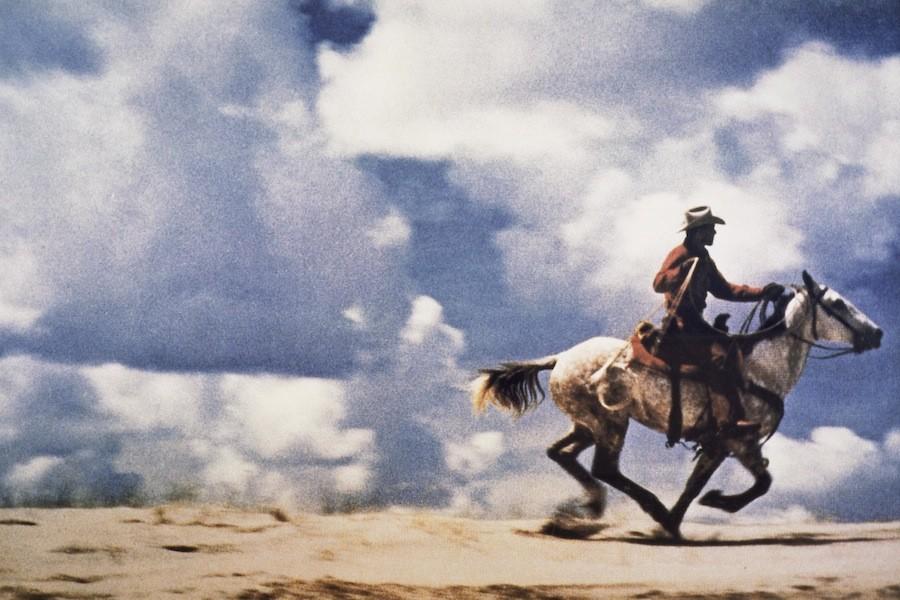
To create this photo series, Richard Prince appropriated a few pictures from an advertizing of Marlboro cigarettes that was popular in the end of the 1970s. It is very important to pay attending to the reaction of the club to this innovative fox; it may sound surprising but the art customs constitute the artist's solution to be simple and amazing.
This art series was important because it attracted the attention of the society to the issues of singularity of art design and the authorship of art works. What is more, he was using the covers of cheap romance novels to create his pictures. Thus, a serial of pictures called "Nurses" appeared (fig.7, fig.8).
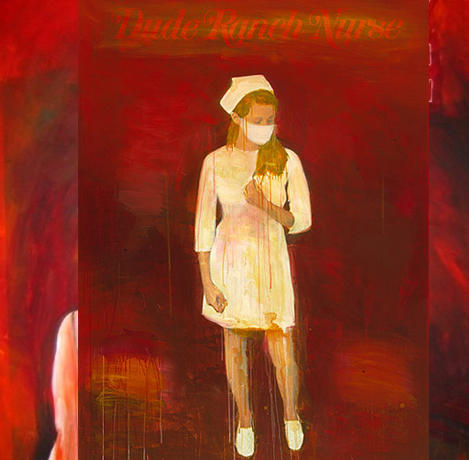
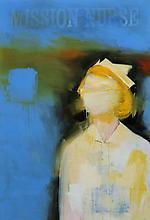
For instance, the images of the secondary characters were covered with paint, and the nurses' facial expressions were changed so that the pictures looked terrifying. These pictures may be regarded every bit the artist's vision of women's image in the society. If we take a wait at these pictures, it becomes obvious that the nurses are sexualized; what is more, they are deprived of their personal characters every bit their faces are covered with medical face up masks. According to Prince's stance, the same is truthful for the women living in modernistic club; it is essential as the ideas of consumer society are and so popular that we offset consuming people. Due to the meaning that he incorporates into these pictures, they tin can be regarded as a mirror reflecting the defects of modern society that keeps living in accord with the pseudo-values.
Conclusion
In the end, it is articulate that contemporary art practices permit artists to become beyond creating only beautiful objects; instead, they are able to express their opinion on many social causes and even fight against political regime. Due to that, contemporary art has turned into the tool reflecting the land of the society and encouraging it to change.
Bibliography
Ertug, Gokhan. "The Fine art of Representation: How Audience-Specific Reputations Bear upon Success in the Contemporary Art Field." Academy of Management Journal 59, no.1 (2016): 113-134.
Horowitz, Noah. Art of the Deal: Contemporary Art in a Global Financial Market place. Princeton: Princeton University Press, 2014.
McEvilley, Thomas. Capacity: The History, the World, and the Cocky in Contemporary Fine art and Criticism. New York: Routledge, 2016.
Osborne, Peter. Anywhere or Not at All: Philosophy of Contemporary Art. London: Verso, 2013.
Shanken, Edward. Gimmicky Art and New Media. Oxford: John Wiley, 2016.
Smith, Terry. What is Contemporary Art? Chicago: University of Chicago Printing, 2011.
Velthuis, Olav. Talking prices: Symbolic meanings of prices on the marketplace for contemporary art. Princeton: Princeton University Press, 2013.
List of Illustrations
Fig
- Ai Weiwei, Dropping a Han Dynasty Urn, 1995, Web.
- Ai Weiwei, Han Dynasty Urn with Coca-Cola Logo, 1994, Web.
- Ai Weiwei, Forever, 2012, Web.
- Ai Weiwei, Worldmap, 2006, Web.
- Richard Prince, Untitled, 2015, Web.
- Richard Prince, Untitled (Cowboy) , 1989, Web.
- Richard Prince, Dude Ranch Nurse # 2 , 2002-2003, Web.
- Richard Prince, Mission Nurse, 2002, Spider web.
Footnotes
- Noah Horowitz, Art of the bargain: Gimmicky Fine art in a Global Financial Marketplace. (Princeton: Princeton University Printing, 2014), 9.
- Peter Osborne, Anywhere or Not at All: Philosophy of Contemporary Art. (London: Verso, 2013), 6.
- Olav Velthuis, Talking Prices: Symbolic Meanings of Prices on the Market for Contemporary Art. (Princeton:Princeton Academy Press, 2013), 7.
- Gokhan Ertug, "The Art of Representation: How Audition-Specific Reputations Affect Success in the Contemporary Art Field", Academy of Management Journal 59, no.1 (2016): 113.
- Terry Smith, What is Contemporary Art? (Chicago: University of Chicago Press, 2011), 9.
- Edward Shanken, Contemporary Fine art and New Media. (Oxford: John Wiley, 2016), 448.
- Thomas McEvilley, Chapters: The History, the Globe, and the Self in Contemporary Art and Criticism. (New York: Routledge, 2016), 9.
Source: https://ivypanda.com/essays/contemporary-art-practices/
0 Response to "He Highlighted the Undesirable Nature of the Contemporary Art Critic"
Post a Comment