Gif Bored of Redundancy Again Lies
Kickoff believed to have been performed in 415 BC, Euripides' play The Trojan Women tells of the violence committed by the Greeks during their siege of Troy, a city not besides far from the borders of contemporary Syria. Scholars believe Euripides wrote the play equally a critical response to the Athenian slaughter of the people of Melos during the Peloponnesian War.[1] The tragedy draws from an ancient history to speak powerfully against gimmicky war crimes and human trafficking—and classicists have taken great interest in the ways in which the play has been reinterpreted over the past century. Performed in Arabic entirely by Syrian women currently living in refugee camps in Amman, Syria: The Trojan Women provides a platform for Syrian refugees to share their experiences of war through a dramatic reinterpretation of the ancient Greek tragedy.
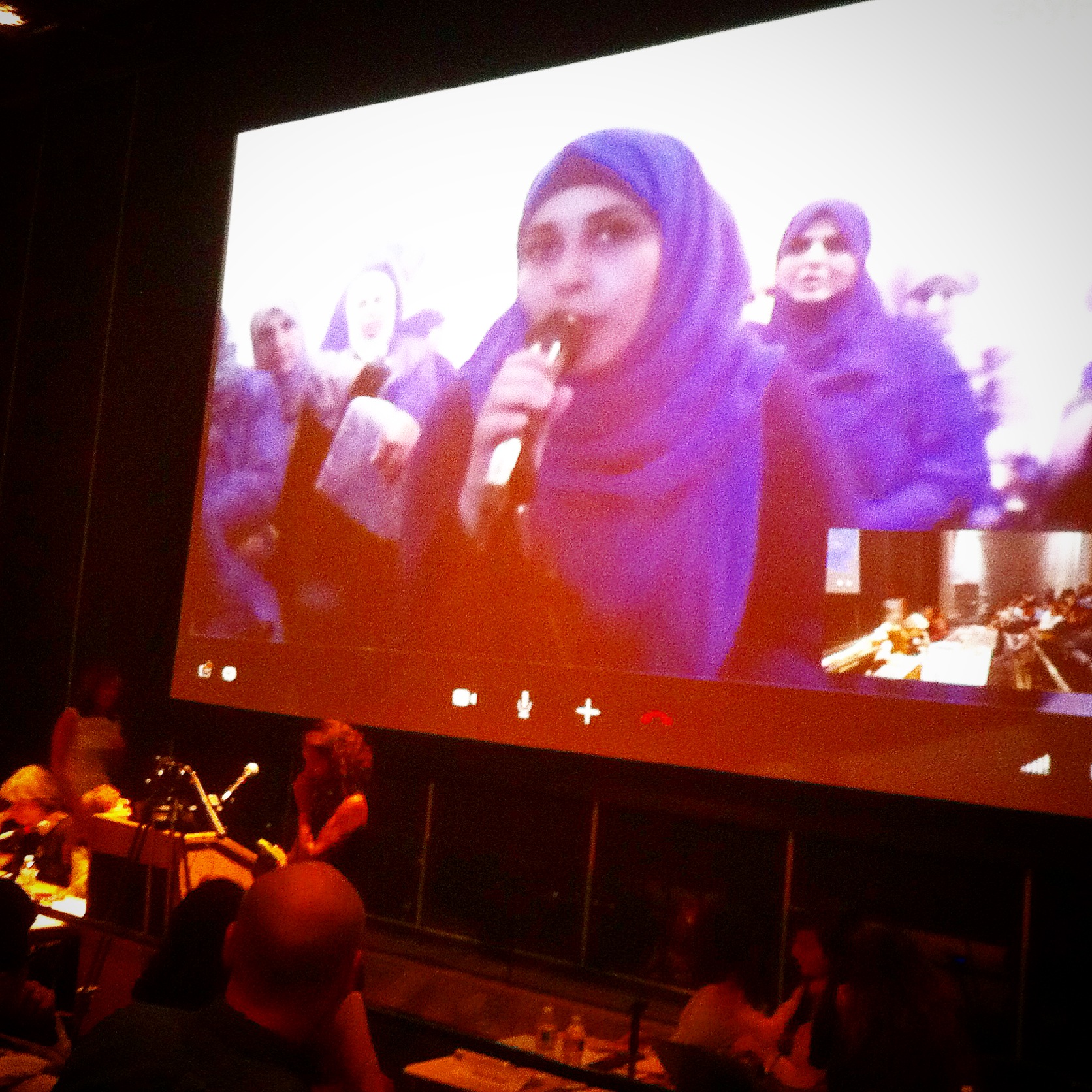
When the performers were recently denied entry visas to the United states, Columbia University organized a promotional event on campus that was attended by many like myself who are currently teaching and studying ancient Greek texts. Over Skype, the Syrian performers spoke about their experiences working on the play in response to questions from their U.Due south. audience. The highly performative aspects of "engaging across a separate"–especially on the U.S. side of the screen–prodigal the moment one of the Syrian women took the microphone, moved her face shut to the calculator photographic camera and surprised her audition by asking in perfect English, "Are you lot bored?" In response to our silence, she raised her voice and enunciated with a broad smile, "Boooooored?" At that moment, her question disturbed and problematized our passive, distant, and comfy consumption of state of war narratives on a screen. The discomfort she provoked flips the spectator's gaze inward, drawing attention to our role not only as audience members simply as crucial participants in the tragedy behind the tragedy. For a project that aims to give a human face up to the suffering that is a consequence of war, achieving this is a success in itself.
A critic might bemoan the repetitiveness of the women's narratives nearly suffering. The empathetic viewer, however, besides as ane familiar with aboriginal Greek tragedies and Homeric epics tin identify the rhythmic ritual of catharsis equally the women repeated stories of disenfranchisement, homelessness, and fright. These performers voiced the back-up and boiler of violence they experienced in a way that mirrored the repetitive passages of violence my students wrestled with understanding in Homer'southward The Iliad. The feel of hearing an ancient text come to life with the Syrian women'southward voices is not only what makes the play and so poignant simply conveys its relevance.
Some critics of the project had raised concerns about cultural imperialism (i.eastward., Why are you imposing western works of art upon them?). This concern, ironically, reflects the distorted way in which the history of western civilization and its cultural heritage is constructed. When critics claim Greek tragedy for 'the west,' they are cartoon from an imagined genealogy that locates the ancient Greek past inside contemporary European geographical and cultural borders. Such concerns deny the intimate historical, socio-political, economic, and cultural connection between the ancient Greek empire's legacy and the Arabo-Islamic world, let alone the role of the latter in transmitting that legacy. The Syrian manager dismissed the concerns about cultural imperialism as consummate hogwash: these classics, he said, were far more familiar to the Arab world than they were being given credit for and have been staged many times before. Simply stated, Troy is far closer to Damascus than London or Milan.
Beyond that, what is most hit is how the performers understood the text. Commonly taught to highly educated Northward American and European readers, Euripides' play emerged as incredibly accessible and familiar to these women, a few of whom were illiterate. A number of the women strongly connected with the queens-turned-slaves motif, mentioning specific lines that spoke most securely to their own state of affairs. The familiarity of the characters and legibility of an ancient text to an illiterate Syrian refugee speak volumes non nearly where the text lies on the scale of high and depression art simply almost how experience can render a text legible. It besides reflects the privilege of those who experience war narratives with detachment and unfamiliarity (even if wars have been fought in their name). As a director in the audience noted, the women's lived feel enhanced the authenticity of their operation in ways that highly trained NYC theater professionals could merely dream of.
The value and appeal of such "authentic" performances raises ethical questions about the emerging market place for theater of war and the "qualified" labor which war provides. In the by few years, a number of theater projects have begun to cast survivors equally performers in retellings of well-known works. For example, Palestinian director Hossam Madhoun wants to bring Tolstoy's War and Peace to the phase in Gaza and apply drama therapy during the workshops to assistance in the healing process of traumatized Palestinian children. In a reinterpretation of Verdi'southward Macbeth, the opera is gear up in a Congolese hamlet by South African director Bret Bailey who works with a troupe of refugee-performers from the conflict zones of the Eastern Congo. The U.S. Section of Defense also caught on several years ago, investing millions of dollars in the Theater of War, a public health theater project that has staged Sophocles' Ajax and Philoctetes in over 50 military sites as well as hospitals.
Syria: The Trojan Women explicitly employs art every bit the neat translator of "foreign" trauma in gild to get in familiar and milkshake the globe of the powerful from a violent silence. Here, this item project again raises the question "How integral is the audition to the meaning and success of a piece of work of art?" In this case, the refugees specifically say they desire the Westward every bit well equally their host countries to understand their suffering and acknowledge their role across the audience as spectator and critic. They believe that art, and particularly a two-thousand year onetime play to which their target audition has ascribed sublime value and has incorporated inside a classical catechism, will convey their bulletin and provoke their audiences to discomfort and action.
[1] See also the "Melian Dialogues" in Thucydides's History of the Peloponnesian War. Trans. Rex Warner (London, England: Penguin, 1972), 400-408.
Source: https://baraza.cdrs.columbia.edu/bored-with-the-theater-of-war/
0 Response to "Gif Bored of Redundancy Again Lies"
Post a Comment